
What Functional Disconnection Means, and How It Gets Assessed: A Parent’s Guide to the Model, the Research, and the Testing
Functional disconnection is a working model of brain development, not a diagnosis anyone will find in a psychiatric manual. The idea is that regions of the brain, including the two hemispheres, can mature at different rates and fall out of sync, and that concerns usually filed under separate labels, such as attention, reading, anxiety, and tics, can share that root. Dr. Robert Melillo, creator of the Melillo Method, co-authored one of the early published formulations of that model, and he has kept publishing on it since.
Most parents meet the term functional disconnection secondhand, from a practitioner, a podcast, or one of the books, and then go looking for whether it is a real thing. Below is what the term means, where it came from, what the research currently supports, and what an assessment actually involves.
TL;DR
- Functional disconnection describes brain regions and hemispheres that may mature at different rates; it is not a classified diagnosis. The American Psychiatric Association describes DSM-5-TR as the standard classification of mental disorders used by mental health professionals in the United States, and this term is not in it.
- Dr. Melillo and Gerry Leisman published an early autism disconnection hypothesis in Reviews in the Neurosciences in 2009, and a 2022 theory article applying maturational-network concepts to ADHD.
- A 2025 meta-analysis pooled 26 resting-state fMRI studies covering 709 people with autism and 705 controls, and reported connectivity differences involving frontal regions, the ventral attention network, and the default mode network.
- At the Melillo Center, day one is full testing with Dr. Melillo’s clinical team, with dozens of functions measured against age-based norms and the plan built from those results.
What functional disconnection means, and why it is a model rather than a diagnosis
Functional disconnection describes how brain regions or hemispheres may communicate, mature, or synchronize differently from one another. It is not a classified diagnosis the way autism spectrum disorder or ADHD are, and no child formally “has” this condition. We describe what testing shows as functional imbalances or asymmetries, and we treat the model as a lens for deciding where to start.
The disconnection concept did not begin as a childhood label. Historical neuroscience examined how damage to the pathways linking brain regions could affect language, movement, memory, and behavior, and a review in Cerebral Cortex on the disconnection syndrome history explains how Norman Geschwind’s 1965 work helped establish a framework for studying how disrupted connections between regions can contribute to symptoms.
In 2009, Robert Melillo and Gerry Leisman published the autism disconnection hypothesis in Reviews in the Neurosciences, proposing that reduced activity and coherence in the right hemisphere could account for features associated with autistic spectrum disorder. The authors framed it as a hypothesis. In 2022, Leisman and Melillo followed with a Hypothesis and Theory article in Frontiers in Neuroanatomy laying out a frontal maturation framework, discussing ADHD through the developmental trajectories of frontal and prefrontal connections. More of that record sits on the research page.
The American Psychiatric Association states in its DSM-5-TR overview, “DSM-5-TR is the standard classification of mental disorders used by mental health professionals in the United States.” Brain connectivity itself remains an active area of research: a 2025 pooled analysis in Autism Research, the autism connectivity meta-analysis, reported differences involving frontal regions, the ventral attention network, and the default mode network.
What happens during a functional disconnection assessment?
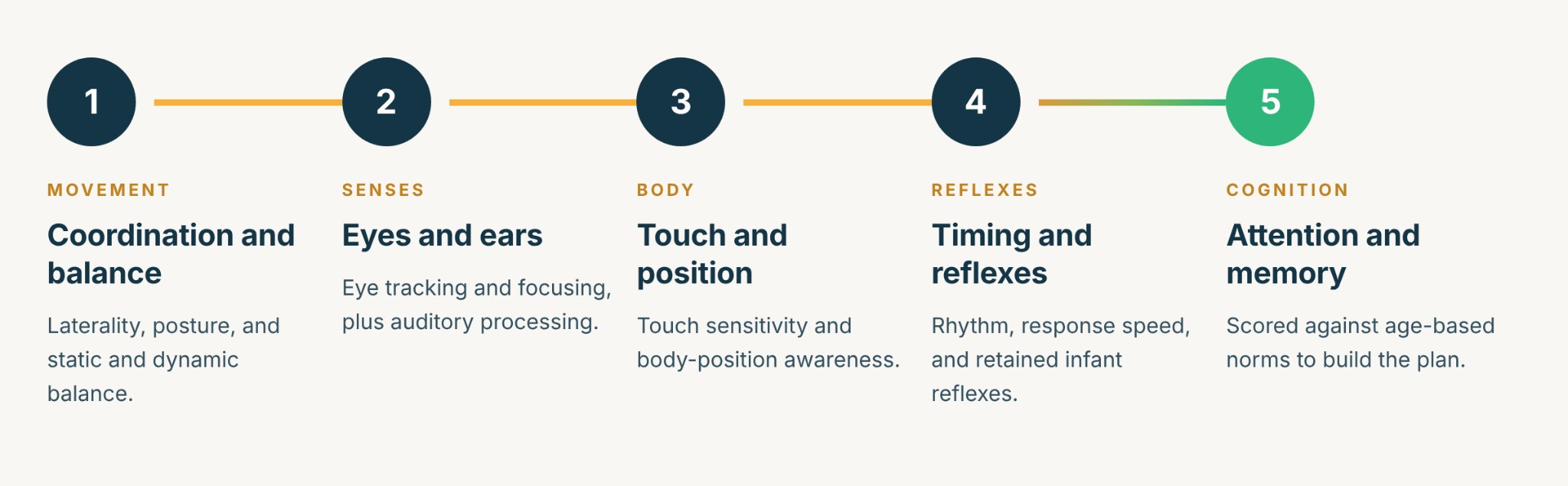
A functional disconnection syndrome assessment, often just called a functional disconnection assessment, is a structured set of measurements across movement, balance, vision, hearing, touch, proprioception, timing, coordination, and cognitive function, including checks of primitive reflexes where clinically appropriate, scored against age-based norms to produce a starting profile. It does not produce a diagnosis, and it is not meant to replace the developmental, medical, psychological, or school evaluations a family already has. In practice, that is how the Center uses the model: as a map of where to start.
The Melillo Center for Developing Minds, founded by Dr. Robert Melillo, creator of the Melillo Method, has offices in Rockville Centre on Long Island and in Manhattan. On day one, Dr. Melillo’s clinical team runs a full evaluation and testing, then sits down with you one-on-one to go through the results and the recommended plan. Testing comes first, every time, and the plan is built from what the numbers show rather than from a set curriculum.
Here is what the assessment typically measures, and why each piece matters.
| What gets measured | What it looks at | Why it matters |
|---|---|---|
| Developmental history and prior evaluations | Milestones, diagnoses, IEP or 504 documents, school and therapy reports | Puts every test result in context and avoids duplicating work |
| Movement and coordination | Gross and fine motor control, laterality, posture | Shows how well the two sides of the body work together |
| Balance and vestibular function | Static and dynamic balance | Balance draws on several systems at once |
| Eye movements | Tracking, focusing, and coordination of the eyes | Visual skills underpin reading and attention |
| Hearing and auditory processing | How sound is taken in and organized | Helps separate listening problems from attention problems |
| Touch and proprioception | Sensitivity to touch and awareness of body position | Sensory responses shape behavior and comfort |
| Timing | Rhythm and response speed | Timing is one way the model looks at how brain regions keep in sync |
| Primitive reflex testing | Whether early infant reflexes still show up in movement | One data point, read alongside everything else |
| Cognitive function | Attention, memory, and processing | Shows strengths as well as areas to support |
None of these rows is a diagnosis on its own. Together, they make up the starting profile a plan should build from.
Mapping domains, rather than reducing a child to one label, has support in the broader literature. A 2024 systematic review and meta-analysis in Developmental Medicine & Child Neurology on coordination assessment found moderate support that motor performance, executive functions, sensory processing and perceptions, cognitive functions, and sports and leisure participation can all be affected in developmental coordination disorder. A companion 2024 review of motor assessment tools recommended the Movement Assessment Battery for Children, Second Edition, for assessing motor activities, based on moderate- to high-quality measurement findings.
Developmental screening follows its own separate timeline. The CDC’s developmental screening overview summarizes American Academy of Pediatrics recommendations for general developmental screening at 9, 18, and 30 months, with autism-specific screening at 18 and 24 months. Those are population milestones. A functional profile is for families who already have concerns and want to know what to work on first.
Why does primitive reflex testing come into it?
This testing looks at early involuntary motor responses that typically integrate during infancy, and checks whether any of them still show up in an older child’s movement. In a functional profile, reflex findings are one piece interpreted alongside age, developmental history, motor function, and the rest of the measures, never a standalone label.
Dr. Melillo co-authored a 2022 narrative review in Frontiers in Neurology on retained reflexes, which discusses the authors’ view that developmental asynchrony in brain networks may be associated with retained primitive reflexes, motor differences, and neurobehavioral features. The same review discusses open questions about how cognitive differences and retained reflexes relate.
Outside research points in similar directions. A 2026 systematic review in Neuroscience and Biobehavioral Reviews examined 14 studies published between 2004 and 2023 involving children ages 3 to 11 without neurodevelopmental disorders, and that primitive reflex review found studies linking persisting primitive reflexes with lower motor and cognitive performance, including locomotion, balance, manual dexterity, reading, spelling, and mathematics. The authors noted that the evidence base is still developing.
A 2023 meta-analysis in Frontiers in Psychiatry pooled four studies totaling 229 samples. That reflex association meta-analysis reported a summary correlation of r = 0.48 between ADHD and asymmetric tonic neck reflex findings, and r = 0.39 for symmetric tonic neck reflex findings, with the authors calling for longitudinal or experimental work on causality.
A 2026 scholarly review of a reflex profiling framework describes reflex profiling as a hypothesis-generating approach, and it is an active area of research, which is exactly why reflex findings belong inside a broader functional assessment rather than standing alone.
Do you need a pediatric neurologist for functional disconnection?
Parents sometimes ask whether they need a functional disconnection syndrome specialist before coming in, and the honest answer is that no specialty owns this territory, because it is a model rather than a diagnosis. There is no credentialed specialist defined this way, the way there is a cardiologist for a heart murmur. A pediatric neurologist, developmental pediatrician, psychologist, or school evaluation team handles diagnosis and medical workup. A functional assessment sits alongside that care and answers a different question: what is this child’s current profile across movement, balance, vision, timing, and cognition, and what deserves attention first? Functional assessment is meant to add to that care, not compete with it.
Dr. Robert Melillo is not a neurologist. He is a chiropractor with a doctorate and a published researcher who has co-authored peer-reviewed papers on brain disconnection models, network maturation, and retained primitive reflexes. He created the Melillo Method after his own three children had neurodevelopmental disorders and he went looking for why, starting with a single room in his office. You can read that story on the about page.
Keeping the line between screening, functional measurement, and diagnosis clear matters. The CDC’s autism screening guidance states, “Screening tools do not provide conclusive evidence of developmental delays and do not result in diagnoses,” and advises that a positive screen be followed by a thorough assessment.
Bring what you already have. Prior evaluations, diagnoses, IEP or 504 documents, school reports, and notes from your pediatrician, speech-language pathologist, or occupational therapist all sharpen the picture the assessment builds, and they help Dr. Melillo’s team coordinate rather than duplicate. Clinicians sending a family our way can start at the referrals page.
How do you choose a functional neurology clinic?
Judge the results of any “functional neurology clinic near me” search by their sequence: testing before any plan, measurements compared against age-based norms, a plan built from your child’s results, and scheduled re-evaluations that show whether the profile is changing. The same standard applies to any functional medicine clinic for neurodevelopmental issues you are considering. If a program hands every family the same curriculum, it is not working from results.
At the Melillo Center, where families travel in from across the tri-state area and well beyond, an intensive runs Monday through Friday with two visits a day. Families go home with a full program and the equipment included, log daily in an online portal, and message the doctors directly through it. Re-evaluations are scheduled every 12 weeks, or every six months for families who travel a long way. Dr. Melillo works with a full clinical team at both offices, so no one is relying on a single practitioner’s bandwidth.
Hundreds of practitioners worldwide are certified in the Melillo Method, and the care delivered at the Center is a more advanced level than what certified practitioners are taught, refined continuously by the person who created it. Coming here means coming to his center.
If your child runs, screams, refuses testing, or has been turned away elsewhere, this is familiar territory. Dr. Melillo’s team works with children like that every week and builds the day around what your child can actually do. Families often tell the team the first thing they notice is something small and domestic: sleep, mood, cooperation, getting through dinner.
The next step is booking an evaluation. If New York is not reachable, the Center offers paid virtual consultations and one-on-one appointments, and the contact page is the fastest way to start.
Frequently asked questions
What does a functional assessment specialist actually do?
A clinician running this kind of assessment measures how a child performs across motor, balance, vestibular, ocular, timing, sensory, and cognitive domains, then interprets the pattern as a set of functional imbalances rather than a diagnosis. At the Melillo Center, that work is done by Dr. Melillo’s clinical team on day one, scored against age-based norms, and discussed with you in person before any plan is written.
What should I look for in a functional medicine program for neurodevelopmental concerns?
Look for testing before planning, age-based norms rather than vague impressions, a plan built from your child’s own results, and written re-evaluation intervals. Ask who delivers the care and how you reach them between visits. Ask how the clinic coordinates with your pediatrician, school team, and any existing therapies, because functional care should add to existing care, not replace it.
How do I find the right functional neurology clinic?
Start with the sequence rather than the signage: a clinic should be able to tell you exactly what it measures, how results are scored, and what happens if the numbers do not move. The Melillo Center is a functional neurology clinic with offices in Rockville Centre on Long Island and in Manhattan, and it offers paid virtual consultations for children and adults who cannot travel to New York.
What does a functional disconnection syndrome assessment include?
Expect a developmental history, a review of evaluations you already have, and direct measurement of movement, coordination, laterality, posture, timing, balance, eye movements, hearing, touch, and proprioception. Primitive reflexes are checked where clinically appropriate. The output is a starting profile and priorities, plus referrals when something belongs with another provider, not a claim that one finding explains everything.
Does a child need to see a neurologist before a functional assessment?
No, because functional disconnection is a research model, not a diagnosis a neurologist codes. See a pediatric neurologist or developmental pediatrician for diagnostic and medical questions. Dr. Melillo is a chiropractor with a doctorate and a published researcher, and the Center’s functional assessment is designed to work alongside the specialists and school supports your child already has.
This article is for informational purposes only and does not constitute medical advice. Always consult a qualified healthcare professional for concerns about your child’s development.
Research cited reflects current findings as of October 30, 2026, and is not a substitute for professional evaluation.
Medically reviewed by the clinical team at Melillo Centers for Developing Minds.
Works Cited
American Psychiatric Association. “DSM.” Psychiatry.org, https://www.psychiatry.org/psychiatrists/practice/dsm.
Centers for Disease Control and Prevention. “Developmental Monitoring and Screening.” CDC.gov, https://www.cdc.gov/act-early/about/developmental-monitoring-and-screening.html.
Centers for Disease Control and Prevention. “Clinical Screening for Autism Spectrum Disorder.” CDC.gov, https://www.cdc.gov/autism/hcp/diagnosis/screening.html.
“Disconnection Syndromes: A Historical Review.” Cerebral Cortex, Oxford University Press, https://pmc.ncbi.nlm.nih.gov/articles/PMC4635921/.
Leisman, Gerry, and Robert Melillo. “Front and Center: Maturational Dysregulation of Frontal Lobe Functional Neuroanatomic Connections in Attention Deficit Hyperactivity Disorder.” Frontiers in Neuroanatomy, 2022, https://www.frontiersin.org/journals/neuroanatomy/articles/10.3389/fnana.2022.936025/full.
Lin, et al. “Resting-State Functional Connectivity in Autism Spectrum Disorder: A Systematic Review and Meta-Analysis.” Autism Research, 2025, https://pubmed.ncbi.nlm.nih.gov/41116298/.
Melillo, Robert, and Gerry Leisman. “Autistic Spectrum Disorders as Functional Disconnection Syndrome.” Reviews in the Neurosciences, 2009, https://pubmed.ncbi.nlm.nih.gov/19774789/.
Melillo, Robert M., et al. “Retained Primitive Reflexes and Potential for Intervention in Autistic Spectrum Disorders.” Frontiers in Neurology, 2022, https://www.frontiersin.org/journals/neurology/articles/10.3389/fneur.2022.922322/full.
“Persisting Primitive Reflexes and Motor and Cognitive Performance in Children: A Systematic Review.” Neuroscience and Biobehavioral Reviews, https://pubmed.ncbi.nlm.nih.gov/42061063/.
“Primitive Reflex Profiling as a Hypothesis-Generating Framework.” Neuroscience and Biobehavioral Reviews, https://pubmed.ncbi.nlm.nih.gov/42311453/.
“Retained Tonic Neck Reflexes and Attention Deficit Hyperactivity Disorder: A Systematic Review and Meta-Analysis.” Frontiers in Psychiatry, 2023, https://pubmed.ncbi.nlm.nih.gov/37484683/.
“Activities and Participation in Developmental Coordination Disorder: A Systematic Review and Meta-Analysis.” Developmental Medicine & Child Neurology, 2024, https://pubmed.ncbi.nlm.nih.gov/39032866/.
“Measurement Properties of Assessment Instruments for Developmental Coordination Disorder: A Systematic Review.” Developmental Medicine & Child Neurology, 2024, https://pubmed.ncbi.nlm.nih.gov/39647307/.

Have questions about your child?
Tell us a little about your family and a member of our team will personally reach out.