

Who Created the Melillo Method, and Where Do You Go to Get It?

Who Created the Melillo Method, and Where Do You Go to Get It?
This article is for informational purposes only and does not constitute medical advice. Always consult a qualified healthcare professional about concerns with your child’s development.
Dr. Robert Melillo created the Melillo Method, and you can receive it in full at the Melillo Center for Developing Minds, with offices in Rockville Centre and New York City. If you have spent any time trying to understand functional neurology for children, retained primitive reflexes, or why a child’s development stalls in ways that are hard to explain, you have almost certainly come across his name.
This article covers where the approach came from, what functional neurology for children actually looks like when a family walks through the door, what Dr. Robert Melillo has published, and how the Center’s full ten-level program differs from the foundation training that practitioners take around the world.
TL;DR
- Dr. Robert Melillo created the Melillo Method, the clinical model at the core of everything the Melillo Center for Developing Minds does.
- The work began at home. Attention and learning difficulties in his own children led him to look for answers the specialists he consulted could not provide.
- He is a published researcher. His peer-reviewed work on retained primitive reflexes and brain development appears in Brain Sciences and the Journal of Paediatrics and Child Health.
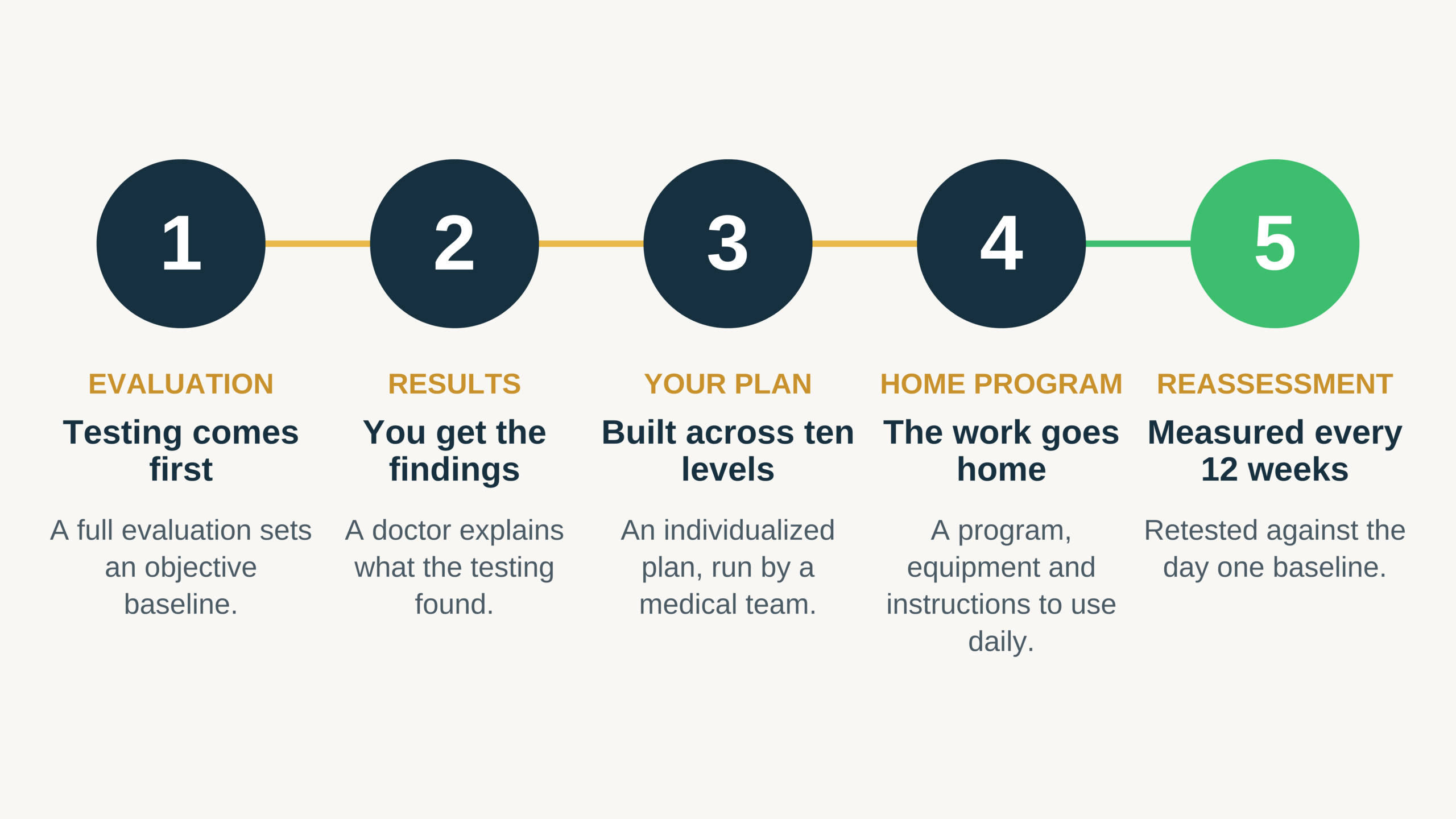
- Care begins with testing: a full evaluation, an individualized plan built across ten levels, a home program, and reassessment roughly every 12 weeks.
- Two New York offices: 119 N Park Avenue, Suite 101, Rockville Centre, NY 11570 and 347 Fifth Avenue, Room 1010, New York, NY 10016. Families travel from across the country and from abroad for intensive programs.
Who created the Melillo Method?
Dr. Robert Melillo created the Melillo Method. It is a clinical model rather than a single technique, device, or supplement, and that distinction is worth holding onto as you compare your options. A model is an evaluation framework, a way to interpret what the testing finds, and a plan built from those findings. It does not mean one intervention applied the same way to every child who walks in.
The Melillo Center for Developing Minds describes the Melillo Method as the core clinical foundation of everything it does. That is a useful phrase for a parent to hold onto, because it tells you that the evaluation, the plan, the home program, and the reassessment schedule all come from one organizing idea rather than from a menu of unrelated services bolted together.
What led Dr. Robert Melillo to develop this approach?
It started at his own kitchen table. Attention and learning difficulties ran through his family, and when his son was diagnosed with ADHD in the early 1990s, Dr. Melillo did what any parent does. He went looking for someone who could tell him what was actually happening inside his child’s brain.
In a published interview, he said he consulted pediatricians, pediatric neurologists, neuropsychologists, and psychiatrists. Four professional disciplines. Anyone who has assembled that kind of referral list knows how it goes: every specialist brings a real, valid lens; every lens explains one piece of the picture; and the parent goes home holding the pieces and wondering how they fit together. That gap, between expertise that is genuine but fragmented and an explanation that holds together, is where Dr. Melillo’s work to build the Melillo Method began.
The search did not stay narrow. He has said that his research after his son’s diagnosis kept expanding into autism, dyslexia, learning disabilities, OCD, tics, and Tourette’s, because the same underlying developmental patterns kept appearing under different labels. That body of research became his first textbook, Neurobehavioral Disorders of Childhood: An Evolutionary Perspective, published in 2004.
The books that followed were written for families rather than for clinicians: Disconnected Kids, Reconnected Kids, Autism, and The Disconnected Kids Nutrition Plan. They are the least expensive way to learn the vocabulary before you book anything, and they are worth reading in that order. A book can teach you the reasoning. It cannot evaluate your child, which is why the Center exists.
What is the Melillo Method?
The Melillo Method is a clinical model designed to identify physical and neurologic imbalances and address the symptoms that come with attention, behavioral, learning, and mental health concerns in children and adults. The Melillo Center for Developing Minds calls the underlying framework the brain developmental blueprint, a way of linking how the nervous system and brain mature with how a child moves and develops physically. In this view, motor development and brain development are not two separate tracks. They are the same track, and that linkage is at the center of functional neurology for children, as Dr. Melillo practices it.
Within that framework, the Center looks for functional imbalances between the two sides of the brain: areas maturing at different rates, so some networks race ahead while others lag. Dr. Melillo’s position has always been that this is a maturational issue rather than damage. Some areas aren’t firing the way they should. That is a very different starting point than assuming something is broken, which is why the evaluation is built to identify specific areas rather than confirm a label.
In practice, that looks deliberately concrete. Individualized plans may include motor training, core stability and coordination work, sensory stimulation, vestibular stimulation, and academic and cognitive training, alongside technology-assisted work such as photobiomodulation, transcranial stimulation, neurofeedback, interactive metronome and gait training, and auditory and visual processing work. Plans are built around frequency, intensity, duration, and function-based goals rather than a fixed protocol every family receives.
One habit runs through all of it, and it is the part parents tend to remember: at the Center, every therapy comes with an explanation. If a child is doing core exercises, a parent should be able to leave knowing that the exercise asks several areas of the brain to coordinate at once, and why that matters for the plan’s goal. Parent education isn’t a nice extra in this model. It’s central to how the whole approach works.
What are retained primitive reflexes, and why does the Center assess them?
Retained primitive reflexes are the early motor and sensory reflexes that every baby is born with, and that normally fade as the nervous system matures. The ones assessed at the Melillo Center for Developing Minds include the asymmetric tonic neck reflex, the symmetric tonic neck reflex, the Moro reflex, the palmar grasp, the Babinski, the tonic labyrinthine reflex, and the rooting, sucking, and snout reflexes. If you have ever gently turned a newborn’s head and watched the arm on that side straighten, you have already seen one of them at work.
A 2025 peer-reviewed review that Dr. Melillo coauthored in the Journal of Paediatrics and Child Health describes primitive reflexes as central to neonatal and infant neurological assessment, and notes that they become harder and harder to elicit through the first year as the central nervous system matures and voluntary movement takes over. That timeline is exactly why a reflex that is still active well past infancy is worth a closer look.
The same review reports that retained primitive reflexes are frequently observed in children with ADHD, autism, and cerebral palsy, and that they may serve as early indicators of developmental delay or nervous system dysfunction. Read that carefully, because the precision matters. An indicator is not a diagnosis. A reflex finding on its own does not diagnose anything, which is why, at the Center, we read it alongside developmental history, functional testing, and whatever a child’s existing providers have already found. It is one instrument in the orchestra, and it is a useful one.
What has Dr. Robert Melillo published?
Dr. Robert Melillo is a published researcher. In 2025, he coauthored a review in Brain Sciences titled “Neurobiological and Behavioral Heterogeneity in Adolescents with Autism Spectrum Disorder,” which lists the Center for Developing Minds in Rockville Centre among the authors’ affiliations. It synthesizes research on how autism can present differently during adolescence and argues for coordinated, individualized, family-centered care, which fairly describes how the Center works.
Also in 2025, he coauthored the review on retained primitive reflexes described above, in the Journal of Pediatrics and Child Health. In 2023, he also coauthored a study in Brain Sciences, “The Relationship between Retained Primitive Reflexes and Hemispheric Connectivity in Autism Spectrum Disorders,” which measured qEEG spectral and functional connectivity before and after an intervention in participants with retained primitive reflexes.
That corpus goes back roughly two decades, and much of it was coauthored with academic collaborators. The Center keeps a research library on its site with the current and older papers on autism, primitive reflexes, functional connectivity, and cognitive motor development, and reading it directly is a reasonable step for any parent doing their homework.
What happens during an evaluation at the Melillo Center for Developing Minds?
It begins with testing, not treatment. The first examination is a physical and neurological evaluation using standardized tools, together with checklists and functional testing that establish an objective baseline. That baseline is the whole point: without a starting measurement, there is no honest way to talk about change later.
The testing goes beyond a single-discipline evaluation. The Center reviews vision and visual processing, hearing and auditory processing, balance and inner ear function, tactile processing, proprioception, smell, and cognitive function. That range is the framework it uses. If motor and sensory systems are part of how the brain matures, then they belong in the evaluation rather than in somebody else’s office.
Age changes what is possible, and the Center is straightforward about it. Some objective functional tests are not feasible for children under five, so for very young children the process leans more on checklists and direct examination. If you have a toddler or a preschooler, ask exactly what can be measured at that age and what will be inferred, and expect a specific answer.
Then comes the plan, where the individualization lives. Plans are built across the Melillo Center for Developing Minds ten levels, set by frequency, intensity, and duration, and aimed at function-based goals, with motor, sensory, vestibular, cognitive, and academic components delivered by a medical team. Every patient goes home with a home program, with the equipment it calls for and video and written instructions covering placement, frequency, duration, and intensity. Families log progress daily in the Center’s portal and message the doctors directly between visits, where most of the hours in any week actually are.
Reassessment is scheduled rather than improvised. Most patients are reevaluated every 12 weeks, and families traveling long distances reassess every six months. Progress is measured against the day one baseline.
One more thing: worrying keeps parents from picking up the phone at all. Plenty of families arrive convinced their child will not cooperate and that they have already been somewhere that did not know what to do with them. At the Melillo Center for Developing Minds, children who are hard to engage aren’t the exception. They’re much of what the team does every day. So before you decide it won’t work for your child, come in and let them show you what’s possible.
Where do you go to get the Melillo Method?
The Melillo Center for Developing Minds has two offices, both in New York.
The Long Island office, and the original one, is at 119 N Park Avenue, Suite 101, Rockville Centre, NY 11570. The Manhattan office is at 347 Fifth Avenue, Room 1010, New York, NY 10016. Both are staffed by doctors, run the same clinical model, and handle inquiries centrally.
How families access the program depends mostly on how far away they live. For out-of-state and international families, the Center runs intensive programs of one to four weeks, with therapy twice a day Monday through Friday, beginning with a full evaluation on day one. One week is the most common length for families traveling within the United States, and two weeks for families coming from abroad; roughly half of the Center’s weekly patients come from outside the country.
Families in the New York area usually take a different path: an evaluation and testing visit, then a one-on-one meeting with a doctor to go through the results and what the plan would involve, then ongoing visits at a pace that fits the family. Virtual appointments are available for families who cannot travel. The Center sees infants through adults and has deliberately widened that range, because the same developmental questions don’t stop mattering at eighteen.
Request an evaluation with Dr. Melillo’s team, or see our virtual programs if you can’t travel to New York.
How does the Center’s ten level program differ from practitioner training?
This is the question that hinders most people searching for functional neurology for children, so it is worth answering plainly.
Dr. Melillo teaches internationally. Clinicians, therapists, and educators worldwide can take his training and pursue certification in the Melillo Method through the Interdisciplinary Association of Functional Neurosciences and Rehabilitation. That training exists on purpose. He has spent his career trying to get these ideas in front of as many people who work with children as possible, and lecturing to rooms full of doctors is how ideas travel.
That training gives someone the foundation of the model. It is a genuine credential, and it reflects real study. By design, it is a foundation rather than the whole structure, and it is worth knowing that certification in a method documents completed coursework and is separate from the professional license a clinician holds. If you are considering any practitioner, it is fair to ask what license they hold and what that license permits them to evaluate and treat.
For a family weighing functional neurology options for children, that distinction is worth understanding. A medical team delivers the complete ten-level program at the Melillo Center for Developing Minds, in the offices where Dr. Melillo built it and still sees patients. That is the difference in one sentence. The foundation training carries the ideas outward. The Center is where the full program lives.
Side by side, it looks like this.
| Foundation training in the Melillo Method | The Melillo Center for Developing Minds | |
| What it is | Coursework and certification in the foundations of the model | The complete ten-level program |
| Who it is for | Clinicians, therapists, and educators adding the model to their own work | Patients and families, infants through adults |
| Who delivers it | Dr. Robert Melillo, teaching internationally | A medical team at the Center, where Dr. Melillo also sees patients |
| What it covers | The foundations of the Melillo Method | All ten levels, with evaluation, an individualized plan, a home program, and reassessment every 12 weeks |
| Where to find it | Certified practitioners in the United States and abroad | 119 N Park Avenue, Suite 101, Rockville Centre, NY 11570 and 347 Fifth Avenue, Room 1010, New York, NY 10016 |
Frequently asked questions
How do I find a functional neurology specialist for children near me?
Start with your child’s existing licensed healthcare professional, who already knows the history, and ask how any additional approach would sit alongside current care. A search for functional neurology for children will return providers with very different training, so verifiable details matter more than the order of the listings. Judge any provider on what you can check: their state license and discipline, what their scope of practice permits, whether their evaluation process is written down, and how often they reassess. If you are in the New York area, the Melillo Center for Developing Minds is at 119 N Park Avenue, Suite 101, Rockville Centre, NY 11570 and at 347 Fifth Avenue, Room 1010, New York, NY 10016, and the Center works with families well beyond the tri-state area.
Who is the best functional neurology doctor in America?
There is no honest way for an article to name the best functional neurology doctor in America, and any site that claims to be telling you about its marketing rather than its judgment. What you can check are facts. Dr. Robert Melillo created the Melillo Method and is a published researcher whose peer-reviewed work appears in Brain Sciences and the Journal of Pediatrics and Child Health. He sees patients at the Melillo Center for Developing Minds, which delivers the complete ten-level program with a medical team. Those are all verifiable, which is more than most rankings can say.
Who are the top functional neurology specialists in New York?
Lists of the top functional neurology specialists in New York are usually advertising, so it is more useful to look at documented locations, credentials, and processes. The Melillo Center for Developing Minds has two New York offices: 119 N Park Avenue, Suite 101, Rockville Centre, NY 11570, and 347 Fifth Avenue, Room 1010, New York, NY 10016. Dr. Robert Melillo founded the practice and created the Melillo Method, and both offices use the same evaluation, planning, and reassessment process.
Who is the best doctor for retained primitive reflexes?
Rather than hunting for a single best doctor, look for someone who can assess retained primitive reflexes within a licensed scope of practice and then read the findings in context. Peer-reviewed work Dr. Melillo coauthored in 2025 reports that retained primitive reflexes are frequently observed in children with ADHD, autism, and cerebral palsy and may indicate developmental delay. However, they do not diagnose any condition on their own. Any provider you speak to should be able to explain what a specific reflex finding does and does not tell you about your child. At the Melillo Center for Developing Minds, reflex assessment is one part of a much wider evaluation.
How do I find a neurodevelopmental disorder specialist near me?
Begin with the clinician who already treats your child, then assess anyone else on documented facts: license, discipline, scope of practice, a written evaluation process, and stated reassessment intervals. Ask for the proposed plan in writing, including frequency, intensity, duration, home activities, and equipment. Keep existing medical, educational, speech-language, occupational, and mental health supports in place unless the professionals treating your child advise otherwise, and tell each provider what else your child is receiving. The Melillo Center for Developing Minds evaluates infants through adults at both of its New York offices and works with families nationally and internationally.
Sources
Leisman, Gerry, and Robert Melillo. “Evaluating Primitive Reflexes in Early Childhood as a Potential Biomarker for Developmental Disabilities.” Journal of Pediatrics and Child Health, vol. 61, no. 6, June 2025, pp. 846-51, https://pmc.ncbi.nlm.nih.gov/articles/PMC12128709/.
Leisman, Gerry, et al. “Neurobiological and Behavioral Heterogeneity in Adolescents with Autism Spectrum Disorder.” Brain Sciences, vol. 15, no. 10, 2025, art. 1057, https://www.mdpi.com/2076-3425/15/10/1057.
Melillo, Robert, et al. “The Relationship between Retained Primitive Reflexes and Hemispheric Connectivity in Autism Spectrum Disorders.” Brain Sciences, vol. 13, no. 8, 2023, art. 1147, https://pmc.ncbi.nlm.nih.gov/articles/PMC10452103/.
Melillo Center for Developing Minds. “About Dr. Melillo.” https://www.drrobertmelillo.com/about-dr-melillo/.
Melillo Center for Developing Minds. “New York Offices.” https://www.drrobertmelillo.com/ny-office/.
Melillo Center for Developing Minds. “Research.” https://www.drrobertmelillo.com/research-page/.
ImpactParents. “Complex Kids Are Gifted (and Other Secrets About Their Brains).” https://impactparents.com/complex-and-gifted-kids/.
Have questions about your child?
Tell us a little about your family and a member of our team will personally reach out.